
Email Marketing ROI - The Ultimate Guide to Higher Returns and Reliable Growth
Learn how to calculate and improve email marketing ROI. Get proven tips, real statistics, and tools to boost your returns.
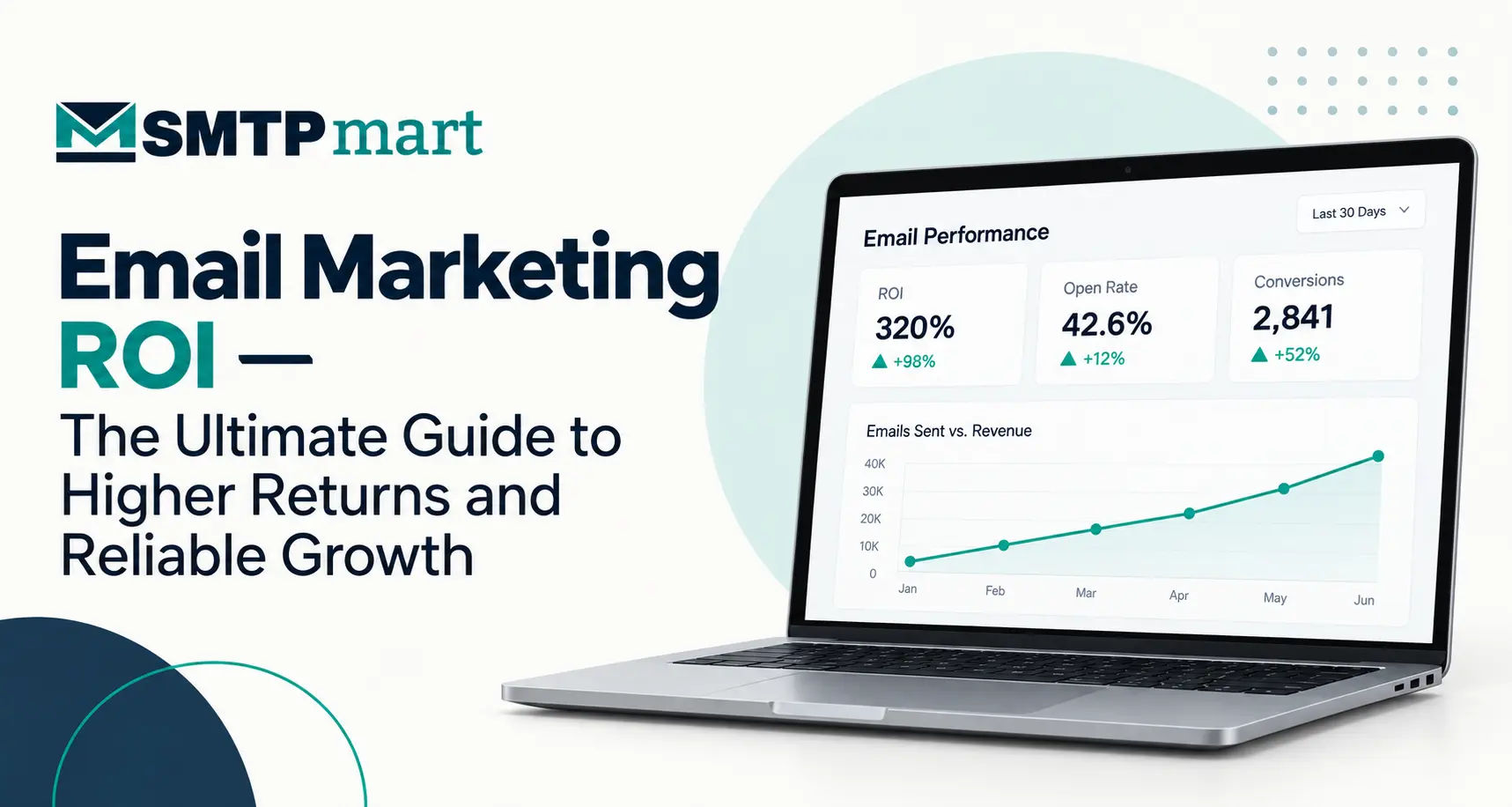
Every business wants to know if their marketing money is being spent well. That is exactly why email marketing ROI is one of the most talked about numbers in the marketing world. It tells you, in clear terms, how much you are getting back for every rupee or dollar you put into email campaigns.
In this guide, we will explain what email marketing ROI means, how to calculate it, what the latest email marketing statistics show, and most importantly, how you can improve your own returns. By the end, you will have a clear plan to get the best email marketing ROI for your business.
What Is Email Marketing ROI?
Email marketing ROI simply means the return you get compared to the money you spend on your email campaigns. In simple words, it answers one question. For every dollar you spend on email marketing, how much do you earn back?
This number matters because it helps you decide where to put your marketing budget. If email marketing return on investment is high, it makes sense to spend more time and money on it. If it is low, you know something needs to change.
Unlike many other marketing channels, email tends to give a very reliable email marketing ROI. This is because you are talking directly to people who already know your brand, instead of showing ads to strangers who may or may not be interested.
How to Calculate Email Marketing ROI
Calculating email marketing ROI is not complicated. Here is the basic formula:
ROI = (Revenue from Email minus Cost of Email) divided by Cost of Email, then multiplied by 100
Let us break this down with a simple example.
Suppose you spend $500 on an email campaign for a month. This includes your email tool cost, design work, and any other related expenses. From that campaign, you earn $2,500 in sales.
Here is how the math works:
Revenue minus cost equals $2,500 minus $500, which is $2,000
$2,000 divided by $500 equals 4
4 multiplied by 100 equals 400% ROI
This means for every dollar you spent, you earned four dollars back. That is a strong return by any standard.
Email Marketing Statistics You Should Know
Before we talk about improving your numbers, it helps to know where the industry stands today. These email marketing roi statistics give you a benchmark to compare your own results against.
Average returns are very high. Email marketing generates an average return of $36 to $42 for every dollar spent, which works out to a 3,600% to 4,200% return on investment that consistently outperforms paid search, social media advertising, and display ads.
Some industries see even bigger returns. Retail, eCommerce, and Consumer Goods businesses often see the highest email ROI of any sector, reaching close to 4500%, while Marketing, PR, and Advertising also beat the average at 4200%.
Personal emails perform better. Personalized email marketing generates a median ROI of 122%, showing that generic, one size fits all emails simply do not perform as well as messages built around the reader.
Marketers trust email the most. About 41% of marketers say email is their most effective channel, placing it far ahead of social media and paid search.
Automation carries a lot of weight. Automated email flows account for 41% of total email revenue despite making up just 5.3% of all emails sent. This shows how powerful a small number of smart, automated emails can be.
These numbers show why so many businesses treat email as one of their most valuable channels. Now let us look at what actually drives these results.
Factors That Affect Email Marketing ROI
Not every business gets the same best email marketing ROI, even within the same industry. Several factors decide how strong your results will be.
1. List Quality
A smaller list full of real, interested subscribers will always beat a large list full of inactive or fake addresses. Clean lists lead to better open rates, better click rates, and better sales.
2. Personalization
Emails that use the subscriber's name, past purchases, or browsing history tend to perform much better. People respond to messages that feel written for them, not mass blasted to everyone.
3. Segmentation
Splitting your list into smaller groups based on interest, location, or buying behavior lets you send more relevant emails. This directly improves your ROI on email marketing because each group gets content that actually matters to them.
4. Send Timing
Sending emails when your audience is most likely to check their inbox can boost open rates significantly. Testing different days and times helps you find what works best for your specific audience.
5. Email Design and Content
Clear, simple, and easy to read emails perform better than cluttered ones. A strong subject line, a clean layout, and a clear call to action all play a role in whether someone opens, reads, and clicks your email.
6. Automation
Automated emails, like welcome series, abandoned cart reminders, and post purchase follow ups, run on their own and often bring in steady, predictable revenue without much extra effort.
How to Improve Your Email Marketing ROI
Now let us get into the practical part. Here are proven steps to help you build a stronger and more reliable email marketing ROI over time.
Step 1: Clean Your Email List Regularly
Remove inactive subscribers who have not opened your emails in months. A clean list improves your deliverability, meaning more of your emails actually reach the inbox instead of the spam folder.
Step 2: Build Smart Automated Flows
Set up a welcome email series for new subscribers, an abandoned cart flow for shoppers who did not finish checkout, and a follow up sequence after every purchase. These flows work around the clock and often bring some of the best email marketing ROI with very little ongoing effort.
Step 3: Personalize Every Message
Use the data you already have. Mention the subscriber's name, recommend products based on what they viewed or bought, and adjust your messaging based on their stage in the buying journey.
Step 4: Segment Your Audience
Do not send the same email to everyone. Group your subscribers by their interests, purchase history, or engagement level, and send each group content that fits them best.
Step 5: Test Your Subject Lines
Small changes in wording can make a big difference in open rates. Try testing two different subject lines on a small part of your list, then send the winning version to everyone else.
Step 6: Track Your Numbers Closely
Keep an eye on your open rate, click rate, conversion rate, and unsubscribe rate. These numbers tell you what is working and what needs to change.
Step 7: Use AI Tools Where It Makes Sense
Many email platforms now offer AI features for subject lines, send time optimization, and audience segmentation. Businesses using these tools often see notably stronger campaigns compared to those relying only on manual methods.
Common Mistakes That Lower Email Marketing ROI
Even experienced marketers make mistakes that quietly hurt their results. Watch out for these common issues.
Sending too often. Bombarding subscribers with daily emails can lead to higher unsubscribe rates and lower engagement over time.
Ignoring mobile users. A large share of people check email on their phones, so emails that do not display well on mobile lose a lot of potential clicks.
Skipping segmentation. Sending the same message to your entire list, regardless of their interests, usually leads to weaker results.
Weak subject lines. If your subject line does not grab attention, the rest of your email never even gets seen.
Not testing anything. Guessing what works instead of testing different subject lines, send times, or content formats means you are leaving results on the table.
Forgetting to clean your list. An old, unused list drags down your open rates and can even hurt your sender reputation over time.
Avoiding these mistakes alone can lead to a noticeable improvement in your results.
Tools to Track and Measure Email Marketing ROI
To keep improving, you need to measure your results properly. Here are some tools that can help:
Email marketing platforms like SMTPmart, Klaviyo, and ActiveCampaign come with built in reporting for opens, clicks, and revenue. If managing these tools yourself feels like too much, many businesses choose to work with professional email marketing services instead, so campaigns are set up and optimized correctly from the start.
Google Analytics can help you track what subscribers do after they click through from your email to your website.
ROI calculators, offered by several email platforms, let you estimate your expected return based on your list size and typical performance numbers.
Spreadsheets, if you prefer a simple, manual approach, can still work well for smaller businesses tracking costs and revenue by hand.
Whatever tool you choose, the key is to check your numbers regularly, not just once and forget about it.
Final Thoughts
Email marketing ROI is not just a number to report to your boss or client. It is a clear signal that shows whether your email strategy is actually working. The email marketing statistics we covered in this guide prove that email remains one of the strongest, most reliable channels available today, often delivering a return that few other marketing methods can match.
If you focus on list quality, personalization, segmentation, and smart automation, you will naturally build a reliable email marketing ROI that grows stronger over time. Email marketing highest roi results do not happen by accident. They come from consistent effort, regular testing, and paying close attention to what your audience actually responds to.
Start with the basics covered in this guide, track your progress, and keep improving one step at a time. Over time, you will see your own email marketing ROI numbers climb, giving you one more strong reason to keep investing in this channel.
Frequently asked questions
A good email marketing ROI is usually anywhere between 300% and 4200%, depending on your industry and how well your campaigns are set up. Most businesses aim for at least 300% to 400%, though top performing brands with strong automation and personalization often see much higher numbers.
Related articles
Sep 17, 202612 min read
Cold Email vs Warm Outreach - The Complete 2026 Comparison Guide
Cold email vs warm outreach — which one actually works in 2026? Compare reply rates, deliverability tips, and a smarter combined strategy.
Read more
Sep 11, 202611 min read
What is BIMI? A Simple Guide to Showing Your Logo in Every Inbox
What is BIMI and how does it work? Learn what BIMI means, why it matters for email marketing, and how to set it up to show your brand logo in every inbox.
Read more
Sep 9, 202610 min read
Email Marketing Benchmarks 2026: The Complete Guide by Industry
Compare your email marketing benchmarks by industry for 2026. Get open rate, click rate & KPI data, plus tips to improve every metric.
Read more