
You send emails every week. You track opens, clicks, and sales. But how do you know if your numbers are actually good? This is where email marketing benchmarks play a major role.

These numbers are what you compare your own results against. Without them, a 20% open rate means nothing. Is that good? Bad? Average? You cannot tell unless you know what other businesses in your industry are getting.
In this guide, You will learn what a good open rate looks like, what a good click rate looks like, and how your industry compares to others. We will also share proven benchmark email marketing strategies for 2026, and how a reliable benchmark email marketing service like SMTPmart can help you get there. Let’s get started.
What Are Email Marketing Benchmarks?
An email marketing benchmark is simply a standard number. It tells you how well an average email campaign performs. Businesses use these numbers to check their own results, spot problems, and set new goals.
Think of it like a report card. If your open rate is 25% and the industry average is 35%, you know something needs fixing. Maybe your subject lines are weak. Maybe you are sending emails at the wrong time. Without a benchmark, you would never know there was a problem in the first place.
When people talk about benchmark email marketing, they usually mean five to six core numbers:
- Open rate
- Click rate
- Click-through rate (CTR)
- Conversion rate
- Bounce rate
- Unsubscribe rate
Each one tells a different part of the story. Together, they give you a full picture of how your campaigns are doing.
Why Tracking These Numbers Matters for Your Business
Some business owners think tracking numbers is a waste of time. They just want to send emails and see sales come in. But without knowing the numbers behind those sales, you are basically guessing.
Here is why email marketing kpi benchmark tracking is worth your time:
1. You get real context
A 2% click rate might sound low. But if your industry average is 1.5%, you are actually doing better than most. Benchmarks give meaning to your raw numbers.
2. You find weak spots faster
If your bounce rate is much higher than normal, you know your email list needs cleaning. If your unsubscribe rate is too high, your content or email frequency may be the problem.
3. You set goals based on facts, not guesses
Instead of picking a random target like “10,000 opens this month,” you can set a goal based on what similar businesses actually achieve.
4. You track real progress
Benchmarks help you see if your changes are working. Did that new subject line style improve your open rate? Compare it to last month and to the industry number.
5. You spend your budget better
When you know which metrics matter most for your industry, you can focus your time and money where it counts, instead of spreading effort everywhere.
6. You get your whole team on the same page
When marketing, sales, and leadership all agree on what “good” looks like, decisions become faster and clearer.
Top Email Marketing Benchmarks You Should Track in 2026
Now let’s look at the actual numbers. These are the top email marketing benchmarks every business should know:
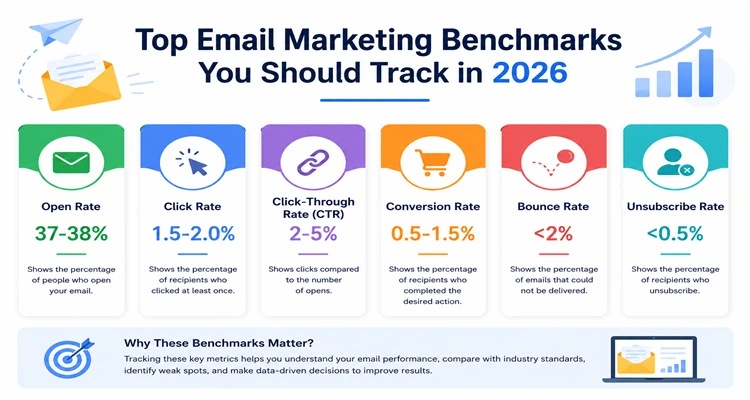
1. Open Rate Benchmark
Your open rate tells you what percent of people opened your email. It shows whether your subject line and sender name are strong enough to grab attention.
Average open rate across industries: around 37-38%
Good open rate: 35% and above is considered strong. Automated emails, like welcome emails or abandoned cart reminders, often perform even better, sometimes crossing 50-60%.
What affects it: subject line, sender name, send time, and how often you email your list.
Takeaway:
- Average open rate: around 37-38%
- Good open rate: 35%+
- Automated emails often beat regular campaigns
2. Click Rate Benchmark
Click rate shows what percent of all emails you sent got at least one click. This tells you if people are not just opening your email, but actually acting on it.
Average click rate: between 1.5% and 2.0%
Good click rate: anything above 2% is considered strong.
What affects it: how relevant your offer is, how clear your call-to-action button is, and how well you have segmented your list.
Takeaway:
- Average click rate: 1.5-2.0%
- Good click rate: 2%+
- Automated flows often reach 3% or higher
3. Click-Through Rate (CTR)
CTR is a bit different from click rate. It measures clicks compared to opens, not compared to total emails sent. It tells you how well your email content convinced people who already opened it.
Average CTR: around 2% to 5%, depending on the type of email
Good CTR: above 5% is seen as strong and shows highly relevant, well-targeted messaging.
Takeaway:
- Average CTR: 2-5%
- Strong CTR: 5%+
- Transactional emails often perform above average
4. Conversion Rate Benchmark
This is the most important number for many businesses. Conversion rate shows what percent of people actually completed the action you wanted, like making a purchase or signing up for something.
Average conversion rate: around 0.08%
Good conversion rate: between 0.1% and 0.3%, with top performers reaching 0.4% or more.
This number looks small compared to open rates, but even a tiny conversion rate can bring in serious revenue when you are emailing thousands of people.
Takeaway:
- Average conversion rate: 0.08%
- Good conversion rate: 0.1-0.3%+
- Top performers: 0.4%+
5. Bounce Rate Benchmark
Bounce rate shows the percent of emails that never reached the inbox. This can happen because of a wrong email address, a full inbox, or a server issue.
Good bounce rate: below 2% is acceptable, below 1% is excellent.
A high bounce rate hurts your sender reputation, which then affects your future open rates too. This is one reason a reliable SMTP provider with strong deliverability tools, like SMTPmart, makes such a big difference.
Takeaway:
- Good bounce rate: under 2%
- Excellent bounce rate: under 1%
- Clean lists and verified addresses help keep this low
6. Unsubscribe Rate Benchmark
This number shows how many people opted out of your emails. A small amount is normal. A high number means something is wrong with your content, frequency, or targeting.
Good unsubscribe rate: below 0.3%, with under 0.2% considered strong.
Takeaway:
- Average unsubscribe rate: 0.1-0.5%
- Good unsubscribe rate: under 0.3%
- Strong unsubscribe rate: under 0.2%
Email Marketing Benchmarks by Industry
Not every business is the same, and not every industry gets the same results. This is why looking at email marketing benchmarks by industry gives you a much more accurate picture than looking at one general average.
Here is a simple breakdown of how different industries usually perform:
- Sports & Recreation: Highest open rates, thanks to time-sensitive offers and strong visuals
- Technology & Electronics: Highest click rates and CTR, because of clear, product-focused content
- Food & Beverage: Strong conversion rates and very low bounce rates, showing clean list habits
- Fashion & Apparel: Good open rates but lower click rates due to heavy competition and frequent promotions
- Beauty & Personal Care: Generally lower open and click rates compared to other industries
- Health & Wellness: Performs well across almost every metric
If your business falls into one of these categories, use these numbers as your starting point. Then check your own results against them to see where you stand.
Comparing your results to accurate email marketing industry benchmarks, instead of a single generic average, gives you a much fairer and more realistic picture of how well your email campaigns are truly performing.
Common Mistakes That Hurt Your Results
Even experienced marketers make small mistakes that quietly damage their numbers over time. Here are the most common ones to watch out for.
Buying email lists
Purchased lists are full of invalid or uninterested addresses. This instantly raises your bounce rate and can get your domain flagged as spam, which drags down every other metric too.
Sending too often
Emailing your list every single day, without strong value behind each message, leads to fatigue. This usually shows up as a rising unsubscribe rate within a few weeks.
Ignoring mobile users
More than half of all emails are opened on a phone. If your email doesn’t look right on a small screen, people close it before reading, which quietly hurts your click rate.
Sending the same email to everyone
Sending one generic email to your entire list, regardless of interest or past behavior, is one of the biggest reasons for low click rates and weak conversion rate numbers. Segmented emails almost always perform better.
Skipping subject line testing
Guessing what subject line will work, instead of testing a few options, means you are leaving open rate improvements on the table.
Ignoring deliverability
Even a perfectly written email fails if it lands in spam. Weak SMTP infrastructure and poor sender reputation are common reasons emails never reach the inbox at all, which quietly damages every benchmark you are trying to hit.
Avoiding these mistakes is one of the simplest ways to protect your benchmark email marketing performance and keep your numbers moving in the right direction.
How to Improve Your Email Performance Metrics
Knowing the numbers is only half the job. The real goal is improving them. Here are some proven benchmark email marketing strategies you can use right away.
Clean Your Email List Regularly
A messy list full of old or fake addresses hurts your bounce rate and your sender reputation. Remove inactive subscribers and verify addresses before sending.
Write Better Subject Lines
Your subject line is the first thing people see. Keep it short, clear, and interesting. Avoid words that trigger spam filters.
Segment Your Audience
Not every subscriber wants the same email. Group your list by behavior, purchase history, or interest. Segmented emails almost always perform better than generic blasts.
Send at the Right Time
Test different days and times. What works for one industry may not work for another. Use your own data to find your best sending window.
Use Automation
Welcome emails, abandoned cart reminders, and post-purchase follow-ups almost always beat regular campaigns. These emails reach people at the exact right moment.
Focus on Deliverability
None of your other efforts matter if your emails land in spam. This is where a strong SMTP relay service becomes important. Good deliverability infrastructure keeps your bounce rate low and your sender reputation strong, which helps every other metric improve too.
Test Everything
Try different subject lines, images, and calls-to-action. Small changes, tested properly, can lead to big improvements over time.
Why Choose SMTPmart to Boost Your Results
Hitting strong performance numbers is not just about writing good content. It also depends heavily on the technology behind your emails. This is where SMTPmart plays an essential role.
SMTPmart is built to help your emails actually reach the inbox, not the spam folder. Here is how SMTPmart supports better numbers across the board:
- Reliable SMTP relay: Keeps your bounce rate low and your emails delivered on time
- Strong sender reputation tools: Helps protect your domain so your open rates stay healthy
- Scalable sending: Works whether you are sending a few hundred emails or millions
- Detailed reporting: Lets you track your own open rate, click rate, and bounce rate clearly, so you can compare against industry numbers easily
- Easy setup: Connect your existing email tools without any technical headache, so you can start improving your numbers right away
If you are serious about improving your email marketing metrics benchmark performance, the foundation has to be strong. A good message with poor deliverability will never reach its full potential. That is exactly the gap SMTPmart is built to fill.
Quick Reference: 2026 Benchmark Cheat Sheet
If you just want the numbers at a glance, here is a simple cheat sheet you can save and check anytime:
| Metric | Average | Good | Excellent |
|---|---|---|---|
| Open Rate | 37-38% | 35%+ | 50%+ (automated) |
| Click Rate | 1.5-2.0% | 2%+ | 3%+ (automated) |
| CTR | 2-5% | 5%+ | 6.5%+ |
| Conversion Rate | 0.08% | 0.1-0.3% | 0.4%+ |
| Bounce Rate | 2-5% | Under 2% | Under 1% |
| Unsubscribe Rate | 0.1-0.5% | Under 0.3% | Under 0.2% |
Keep this table handy the next time you review a campaign report. It takes just a few seconds to check where you stand.
Final Thoughts
Understanding email marketing benchmarks is one of the simplest ways to improve your entire email strategy. Once you know what “good” looks like for your industry, you can set realistic goals, spot weak points quickly, and measure real progress over time.
Whether you are just starting out or already running large campaigns, tracking these numbers regularly will help you make smarter decisions. Combining smart benchmark email marketing strategies with strong deliverability is one of the fastest ways to grow your revenue. And when you pair strong content with a reliable benchmark email marketing service, hitting and beating these benchmarks becomes a lot easier.
Ready to improve your email performance? Get started with SMTPmart today and see how better deliverability can transform your results.
FAQs
Here are some frequently asked questions:
Email marketing benchmarks are average numbers, like open rate, click rate, and conversion rate, that show how well email campaigns typically perform. Businesses use them to measure their own results.
A good open rate is generally 35% or higher. Automated emails, like welcome series, often perform even better.
Different industries have different audiences, buying habits, and email frequency. This is why looking at email marketing industry benchmarks specific to your field gives more accurate insight than a single overall average.
For most businesses, the best email marketing benchmarks to focus on are open rate (35%+), click rate (2%+), conversion rate (0.1-0.3%+), and bounce rate (under 2%). These four numbers give you the clearest picture of overall performance.
Monthly reviews work well for most businesses. This gives you enough data to spot real trends without overreacting to short-term changes.
Yes. A strong SMTP relay and deliverability service directly affects your bounce rate and sender reputation, which then improves your open rate and click rate over time. This is exactly the kind of email marketing metrics benchmark improvement SMTPmart is built to deliver.